MTCTCE86%Active
MikroTik Certified Traffic Control Engineer
Valid May 2025 – May 2028 · Verify on mikrotik.com
I classify, prioritize, and shape traffic so voice and interactive traffic hit their latency targets while bulk transfers fill the remaining capacity.
What this certification validates
Packet classification, QoS, queue trees, bandwidth management — the mechanics that keep traffic prioritized and bandwidth distributed under load.
- ·Packet flow (prerouting→forward→postrouting)
- ·Mangle rules & action types
- ·Connection tracking marks
- ·Routing marks
- ·HTB (Hierarchical Token Bucket) queue trees
- ·Simple queues
- ·Burst configuration
- ·PCQ (Per Connection Queuing)
- ·DSCP marking
- ·Bandwidth test & monitoring
MTCTCE vs No direct equivalent (QoS-specific)
| Dimension | MTCTCE | No direct equivalent (QoS-specific) |
|---|---|---|
| Scope | Packet marking, queuing, shaping on RouterOS | QoS is usually a module within broader certs |
| Vendor lock | MikroTik only | N/A |
| Hands-on depth | Build queue trees and mangle chains on real hardware | Varies by vendor cert |
| Uniqueness | Dedicated traffic control certification | No vendor offers a standalone QoS cert |
| Difficulty | Requires deep packet flow understanding | N/A |
Where I run this in production: Firewall · Addressing
Certification combinations
MTCTCE combines with these certifications.
Case studies
Anonymized engagements demonstrating this expertise.
Case #1
- Situation
- Regional ISP with 2,000 subscribers on a shared 1Gbps uplink experiencing peak-hour congestion.
- Challenge
- Gaming and VoIP users complained about latency. Bulk downloads consumed all available bandwidth. No traffic classification existed.
- Methodology
- Mangle chains to classify traffic by protocol/port/DSCP. HTB queue tree: guaranteed minimum per subscriber, burstable to max, priority lanes for VoIP/gaming. PCQ for fair per-connection distribution.
- Result
- VoIP jitter dropped from 40ms to <5ms. Gaming latency stabilized. Bulk downloads used the remaining capacity without impacting real-time traffic.
Exam details
Exam format and certification details
- Format
- 25 multiple-choice questions, open-book
- Pass score
- 60%
- Duration
- 60 minutes
- Prerequisite
- MTCNA (can be expired for recertification)
- Training
- 2 days
- Validity
- 3 years
- Global rarity
- ~1,000–2,000 active holders
- RouterOS ver.
- RouterOS v7
Score history
Score progression across certification cycles
2016Moscow
2019Kuala Lumpur
2022Bangkok
2025Bangkok
Training providers: MikroTik Russia, Citraweb (ID), MikroTik SEA
Certificate
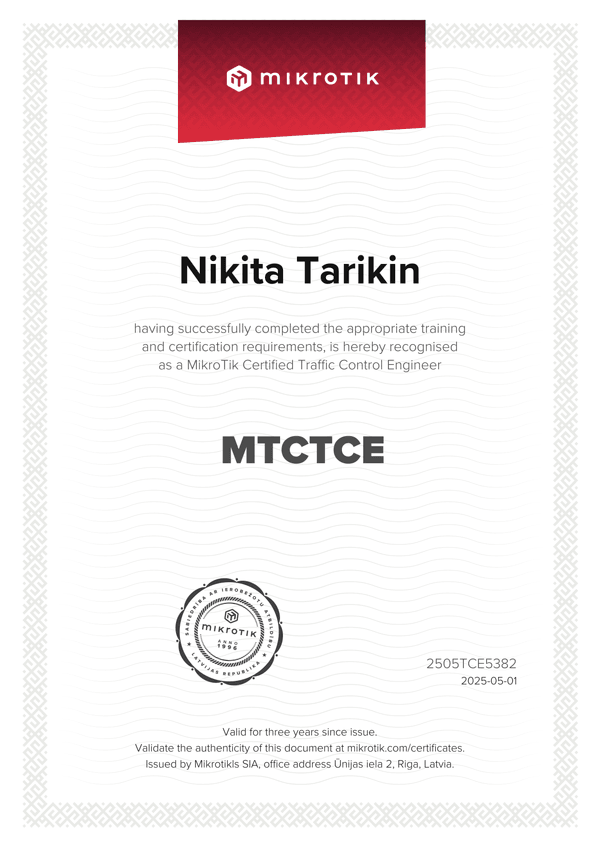
Click to enlarge
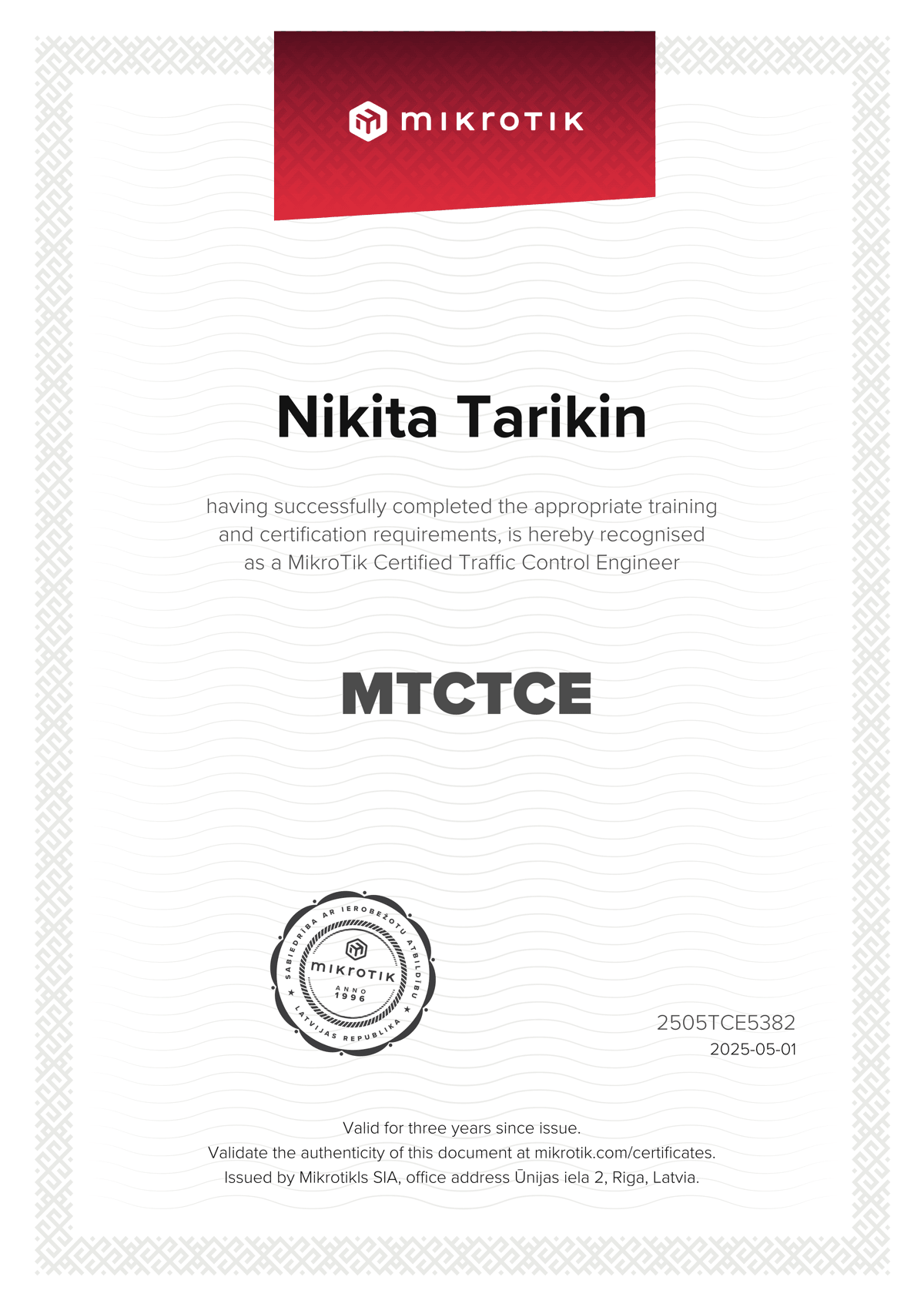
FAQ
What does MTCTCE certification cover?
MTCTCE covers RouterOS packet flow, mangle rules for packet classification, connection tracking marks, HTB queue trees, simple queues, burst, PCQ (Per Connection Queuing), and DSCP marking.
How is MTCTCE different from other QoS certifications?
MTCTCE is the only dedicated traffic control certification from any major networking vendor. Other vendors include QoS as a small module within broader certs. MTCTCE covers packet marking, hierarchical queuing, and connection tracking in full.
What projects require MTCTCE-level expertise?
ISP bandwidth management, multi-WAN traffic engineering, gaming/VoIP prioritization, per-subscriber QoS.
How do I verify a consultant's MTCTCE certification?
Verify on mikrotik.com/certificates using the certificate ID. MTCTCE requires MTCNA as prerequisite.
Is MTCTCE certification still relevant in 2025?
Yes. Networks now carry video, VoIP, gaming, and IoT simultaneously — without per-class queuing the interactive traffic loses. Any ISP or enterprise running mixed-class loads needs this.
See how this expertise applies → Contact
Need MTCTCE expertise?
Let's talk →